Introduced the Popular Use of the Term Expressionism to Describe Art With Strongly Emotional Content
Expressionism existed as a menstruation within art that abased realistic and accurate representations of scenes and subjects in an try to capture the subjective perspective of the artists. Seen as a modernist movement, Expressionism Art adult within Germany prior to World War One earlier spreading out beyond the earth. This broad movement farther developed into a more niche exploration of fine art known as German Expressionism, which went on to define the Expressionist movement throughout its reign.
Table of Contents
- 1 An Introduction to Expressionism Art
- 1.1 Precursors of the Movement
- 1.2 Coining the Name of the Move
- 1.three Expressionism Art Definition
- 1.4 Subsequent Evolution of German Expressionism
- two Characteristics and Influences of Expressionism Fine art
- ii.1 Groups Inside German Expressionism
- 2.two Die Brücke
- two.3 Der Blaue Reiter
- 3 Famous Expressionist Artists and Their Artworks
- 3.1 Edvard Munch (1863 – 1944)
- iii.2 Wassily Kandinsky (1866 – 1944)
- iii.three Franz Marc (1880 – 1916)
- 3.4 Ernst Ludwig Kirchner (1880 – 1938)
- 3.5 Karl Schmidt-Rottluff (1884 – 1976)
- 3.half-dozen Oskar Kokoschka (1886 – 1980)
- 3.seven Egon Schiele (1890 – 1918)
- iv The Legacy of Expressionism Fine art
- 5 Expressionism Art in Other Forms
- five.1 Cinema
- five.2 Drama
- half dozen Summary of the Expressionism Art Movement
- vi.1 What Is Expressionism?
- half dozen.two What Is a Suitable Expressionism Art Definition?
- 6.three Which Painters Were Well-Known Within the Expressionism Art Movement?
- vi.iv What Artistic Groups Developed in Response to Expressionism Within Art?
An Introduction to Expressionism Art
Arising in Frg in 1905, the Expressionism years encompassed an avant-garde movement that fabricated employ of exaggerations and distortions inside artworks to accurately depict 20thursday century life from a subjective perspective. This way of art developed before the start of the Showtime World War and was popular during the Weimar Republic inside Germany, earlier its decline in 1920. In addition to Expressionist painting, the motility extended itself to a wide range of artistic categories, such as literature, drama, and cinema.
Seen to exist as essentially a modernist movement, Expressionism came well-nigh during a period of intense change and upheaval inside Europe. During this time, society was developing at a rapid rate due to the industrialization that had captured the continent, as well as the chaotic state of the world that was nowadays within countries leading up to World War I. This led to German artists responding to these 2 of import events through the artworks they created.
The inventions within the product and communication sphere brought almost a sense of apprehension in the general public. This was due to the expansion in technology in addition to the radical urban development of major cities, which created intense feelings of isolation and detachment from the natural world.
These vivid emotions began filtering into art production at the fourth dimension, as artists expressed their anxieties through a heightened utilize of color, jagged angles, flattened forms, and heavily distorted views.
As the start of the First World State of war loomed, more elements of the grotesque came about in Expressionist fine art. Artists began to experiment with printmaking, equally information technology existed as an efficient way to quickly distribute their work to a larger audience. Additionally, this meant that their artworks that critiqued political and social causes were spread far and wide, which helped deport the emotional significance present in their works beyond traditional artistic society.
Initially, many of the Expressionist artists supported the idea of war, equally they believed that it would atomic number 82 to the defeat of middle-course gild along with its widespread materialistic tendencies and cultural limitations. Nevertheless, as the artists joined or were recruited, their personal feel of the war destroyed their previous feelings of optimism and promise. This led to many artists having mental breakdowns, with these emotions being channeled into the works they created.
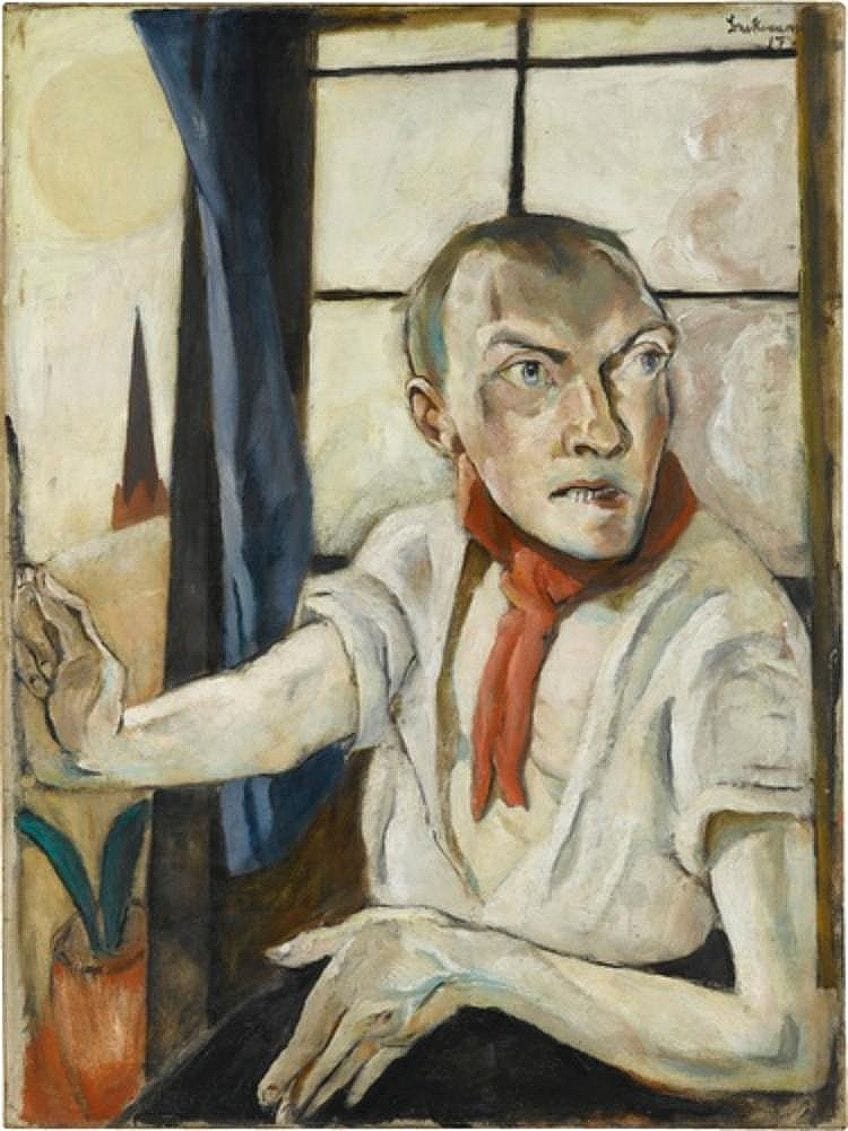 Selbstbildnis mit rotem Schal ('Self-Portrait with Red Scarf', 1917) by Max Beckmann; Max Beckmann, Public domain, via Wikimedia Eatables
Subsequently, artworks that indicated the broken-down minds and bodies of the artists and other individuals were depicted, which gave viewers a more personal insight into the gruesome globe that existed on the battle lines. Thus, Expressionist fine art presented a distorted view of the earth for an emotional issue equally opposed to portraying the grim reality of state of war. This was done to express the emotional experiences of the artists, in improver to their raw and truthful feelings and ideas about the reality in which they lived.
In their quest for actuality, Expressionist painters depicted the world exactly as it felt rather than how it looked, taking inspiration from the bold, vibrant, and introspective paintings that were created in the Mail service-Impressionist era. Artists dismissed the predominant stylistic conventions that had dictated visual creation at the turn of the 20th century in an endeavour to reinvigorate art with conviction and an expressive force.
Precursors of the Motion
The origins of the Expressionist movement tin be linked to artists similar Edvard Munch, Vincent van Gogh, and Henri Matisse. Each creative person began to display signs of a divergence from lifelike portrayals in their later works, as they preferred to capture the personal thoughts and outlooks of their subjects.
Thus, the style of Expressionism made subjective thoughts a defining aspect of the movement, every bit artists rejected realistic and precise representations in favor of exaggerations and distortions that they believed to carry a greater impact.
Out of the artists who were idea to influence the development of Expressionism, Munch and van Gogh existed as the predominant precursors of move, as it was their artwork that held the almost influence. Both artists fabricated use of unnatural colors, dynamic brushstrokes, and overstated textures inside their works, which went on to become essential characteristics of Expressionism Art. This resulted in artworks that gave a subjective look at the current reality that existed, as the works gave a glimpse into the listen of the artists at the time.
Munch's The Scream, painted in 1893, exists every bit a prominent example of the beginning of Expressionism. Very picayune attention was given to an accurate portrayal of the subject area and the mural, as a ghoulish figure is seen standing in a groundwork of whirling lines and harsh, contrasting colors. In doing then, Munch managed to convey the deep pain and intense ache of the figure, which was seen equally more than important than the actual style and limerick of the piece of work.
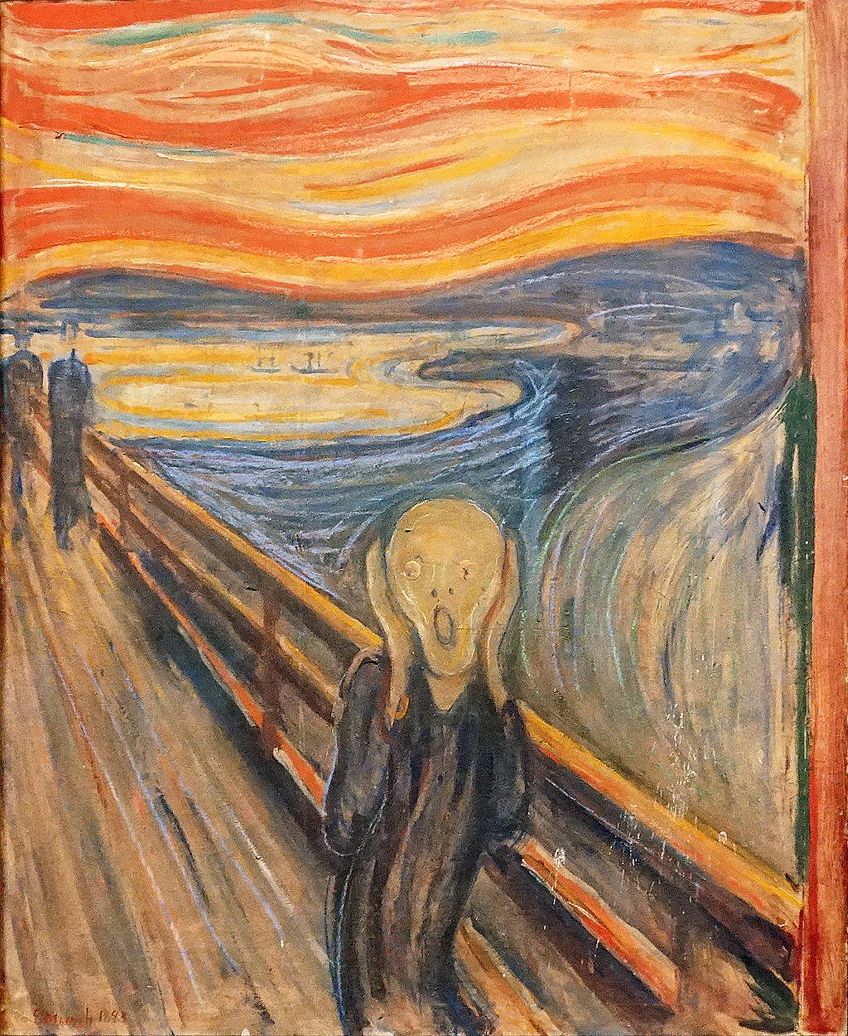 The Scream(1893) past Edvard Munch; Edvard Munch, Public domain, via Wikimedia Commons
Coining the Proper noun of the Motion
The term "Expressionism" was popularized by several writers in 1910 only was supposedly coined past Czech fine art historian Antonin Matějček, who intended the term to mean the opposite of Impressionism. Where Impressionist artists were thought to wait externally to the real earth when capturing instances such every bit nature and the human form, Expressionists were said to search inward for a deeper meaning then every bit to accurately express inner life.
This distinction in style was created through the harsh subject field thing that was depicted, besides as the unrestrictive brushwork, the extended and jagged forms, and the intense colors that were used. While some artists refused to refer to themselves every bit Expressionist, the notion of the movement was and then revolutionary at the time that the term "Expressionism" has come up to represent many styles of contemporary art.
Expressionism Art Definition
Expressionism as an art motility was very wide and thus was very difficult to define. This was because it overlapped with other major movements within the modernist period, such as Vorticism, Cubism, Futurism, Surrealism, and Dadaism. Expressionism also spanned beyond different countries, mediums, and periods, meaning that information technology could not exist divers by a strict set of aesthetic principles.
Rather, Expressionism was viewed as a tool of expression and social critique. While the term mainly applied to artworks that were created in the twentyth century, it encompassed all works that were made in reaction to the dehumanizing impact of industrial development and the expansion of cities.
The label of "Expressionism" sometimes conjured up feelings of malaise, every bit depicted by the artwork that was created, equally the movement existed as an artistic fashion that sought to portray subjective emotions and responses of ordinary people.
Subsequent Development of German Expressionism
As industrialization continued to grow in Europe, artists who started the Expressionist motion migrated to larger cities, bringing with them their ideas surrounding art creation. This led to other artists breaking away to form the subsequent German Expressionism movement, which was characterized past 2 notable groups known as Die Brücke and Der Blaue Reiter.
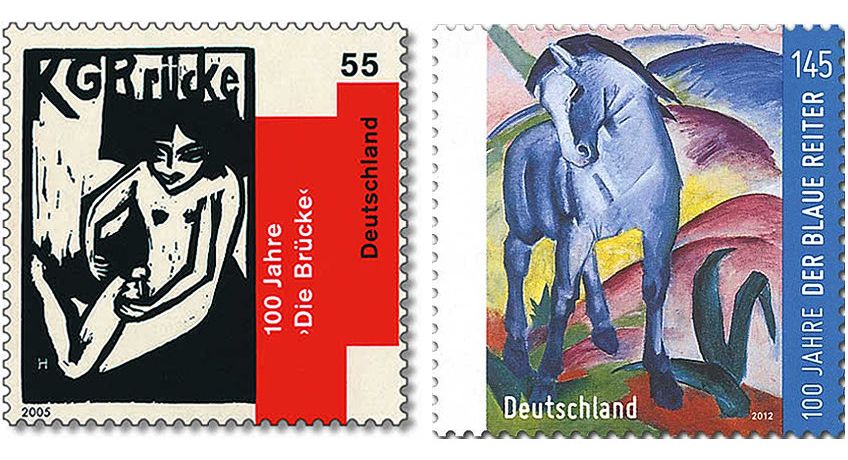 Commemorative stamps of the expressionist movements Die Brücke (left) and Der Blaue Reiter (correct); Left:Prof. Andreas Hoch, für das Bundesministerium der Finanzen und die Deutsche Postal service AG, Public domain, via Wikimedia Commons; Correct:Franz Marc, Public domain, via Wikimedia Commons
Die Brücke, which formed in 1905, was seen equally the founding grouping of the German language Expressionist movement, with Der Blaue Reiter simply forming in 1911. Although both groups did non refer to themselves as German Expressionists, they shared studios, exhibited alongside each other, and went on to publish their piece of work and writing.
The Expressionism Fine art motility emerged in diverse cities across Deutschland in response to the widespread anxiety that arose as an after-issue of industrialization. Artworks portrayed the increasingly despondent human relationship that individuals held with both club and nature in the anarchy that existed prior to and during Globe War One. Due to its success, Expressionism went on to inform other movements like Abstract Expressionism and Neo-Expressionism and because of this, it can be argued that the style still lives on today.
Characteristics and Influences of Expressionism Art
When considering this move, it can be easy to wonder: What is Expressionism? The style of Expression originally started in Federal republic of germany and Austria, where a grouping of artists began creating artworks that made utilise of certain characteristics. These were works that centered around capturing emotions and feelings equally opposed to what field of study matter looked like were created.
Striking colors and bold brushstrokes were used to overemphasize the emotions that were present, which highlighted their importance over a realistic estimation within the artworks.
The Expressionist Art movement demonstrated a heavy influence from other early 20th century movements, such as Mail-Impressionism, Fauvism, and Symbolism. Artists made use of characteristics belonging to other movements when creating Expressionist fine art, which can exist seen in their inclination to make utilise of arbitrary colors and discordant compositions, every bit inspired past the Fauves in Paris.
A chief characteristic of the Expressionism Art move was the exaggeratedly executed portrayal of discipline affair. This, combined with the swirling and swaying brushstrokes that were used, managed to accurately express the turbulent emotional state that artists institute themselves in as a response to their anxieties about the mod world. Through their stark confrontation with the early on 20thursday century urban earth, artists were able to powerfully insert social criticisms into their work, which existed as an important characteristic.
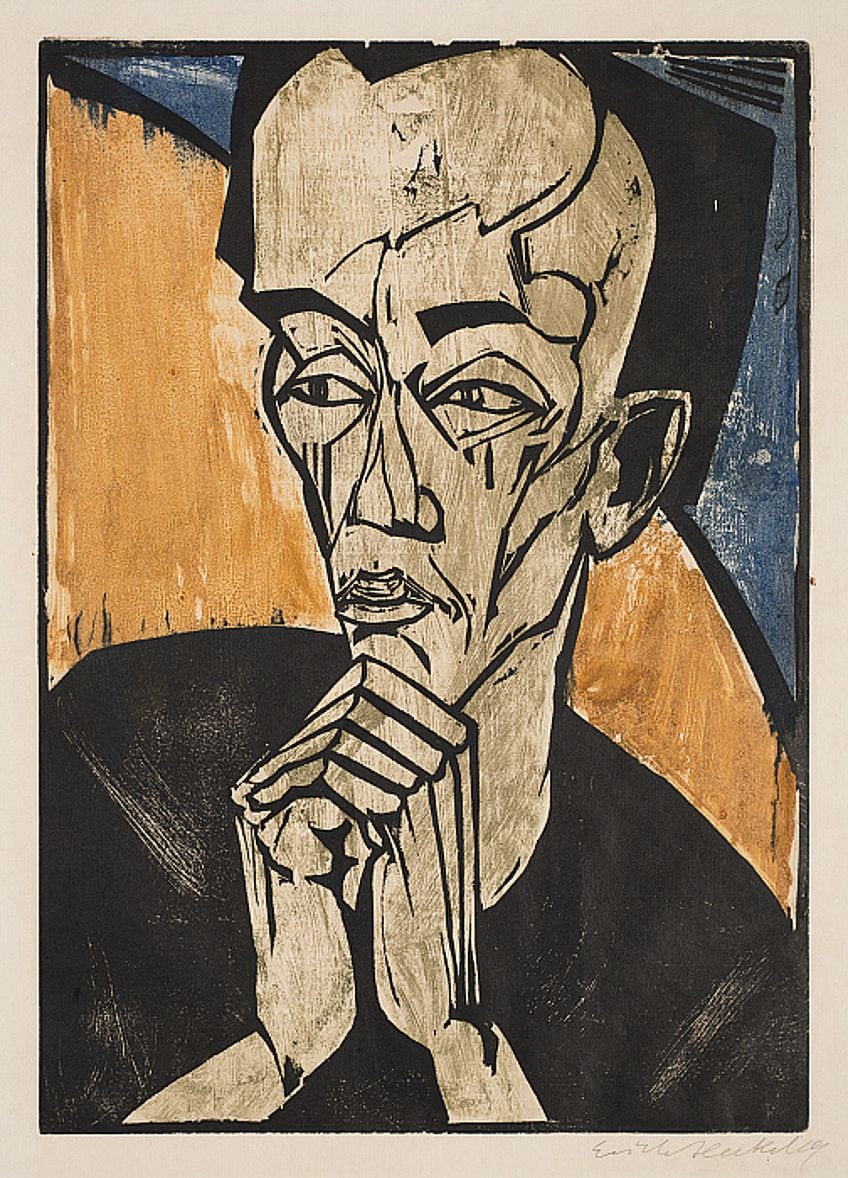 Portrait of a Man (c. 1918) by Erich Heckel; Clark Art Plant, Public domain, via Wikimedia Eatables
This frank depiction of subject matter effectively demonstrated the new principles that existed when fine art was created then judged. Art was now meant to come forward from within the artist themselves rather than from a mere depiction of the outside visual world. The artist's feelings became more than of import when assessing the quality of an artwork, equally an evaluation of the compositional aspects was no longer regarded every bit important.
Thus, the representations of the mod city were sinister, as artists created alienated figural interpretations of individuals. These detached renderings were said to represent the turmoil and anarchy that was present within their psyche at the time due to the growing emotional distancing that existed in society. This separation, which became an e'er-present characteristic within the Expressionist works created, was seen as a major effect of the rapid urbanization that had occurred.
Groups Within German language Expressionism
Once the Expressionism movement had started, two distinct groups were formed by artists which encompassed the different styles and characteristics that were used. These groups, known every bit Dice Brücke and Der Blaue Reiter, led to the specific product of German Expressionism Art during the movement's existence.
Dice Brücke
Founded by artists Ernst Ludwig-Kirchner, Karl Schmidt-Rottluff, Erich Heckel, and Fritz Bleyl, this group was formed in Dresden in 1905. Existing as a nonconformist commonage of Expressionist artists, this group was influenced past the works of Vincent van Gogh and Edvard Munch and went on to create art that went confronting the conservative social order of Federal republic of germany. Nevertheless, all four founding members were only compages students at the time, with none of them ever receiving any formal art education.
The proper name of the group was called to emphasize their desire to create a bridge connecting the past and the nowadays, equally the word brücke simply translated to "span." Additionally, the name was further inspired past a passage of writing from Friedrich Nietzsche, whose writing was considered a cardinal influence on the evolution of Expressionism.
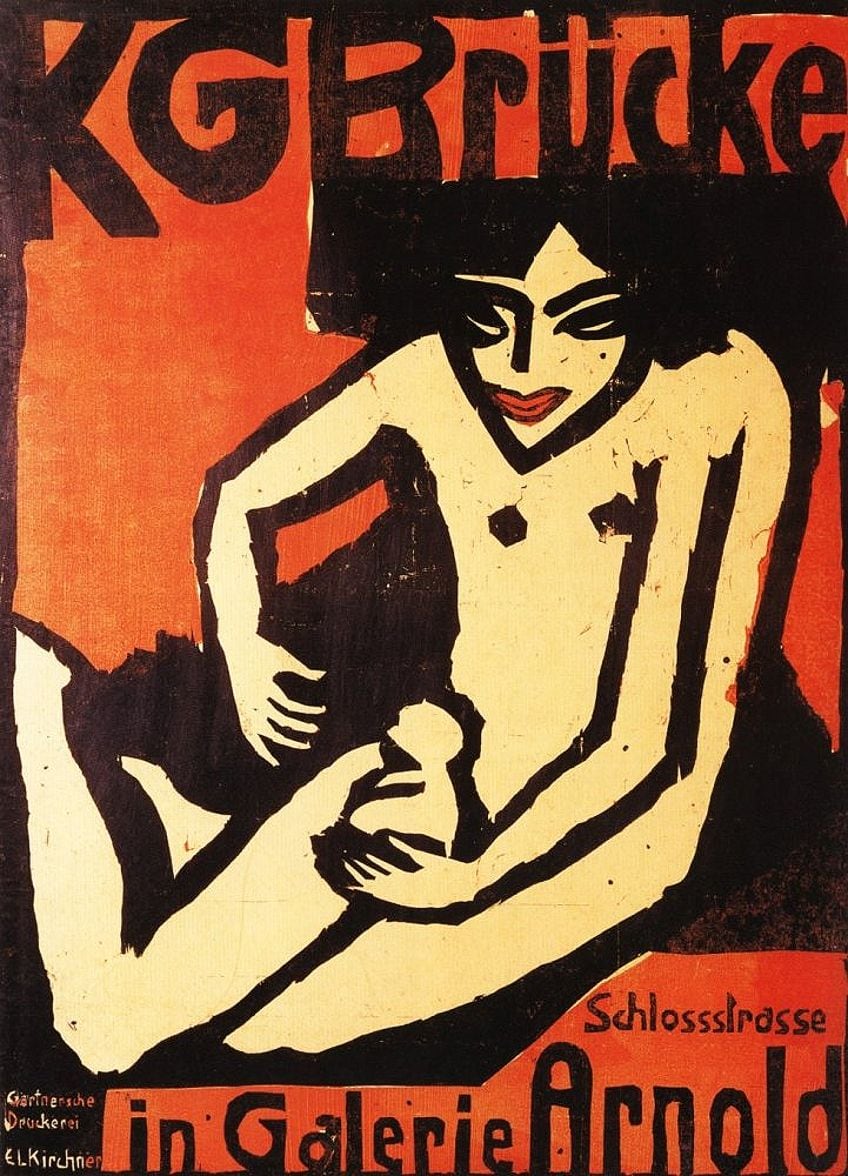 Ernst Ludwig Kirchner'south presentation poster for a Die Brücke exhibition at the Arnold Gallery in Dresden (1910);Ernst Ludwig Kirchner, Public domain, via Wikimedia Commons
The artists within Die Brücke sought to escape the boundaries of contemporary middle-class life through experimenting with a heightened sense of color within their works, which was thought to stand for the raw emotion that existed within social club. Additionally, the straight and simplified arroyo that was taken when rendering form created provocative representations of modern society and demonstrated the freedom of sexuality that was experienced.
Thus, while artists portrayed city inhabitants, bolder works went on to depict prostitutes and dancers working in the urban center's streets and nightclubs. This daring portrayal created artworks that introduced the degenerate underbelly of German society at the time. Unlike the pastoral scenes that were created by Impressionists, members of Dice Brücke purposefully sought to distort forms through the utilize of artificial colors in order to arm-twist a visceral and emotional response from viewers.
Die Brücke collaborated and exhibited works until the group was dissolved in 1913. This was due to a writing slice of Kirschner, titled Chronik der Brücke (Brücke Chronicle), which signaled the ending of the grouping within the same year as the article.
Der Blaue Reiter
Coming into existence after Die Brücke, Der Blaue Reiter was formed in 1911 by artists Wassily Kandinsky, Baronial Macke, Paul Klee, and Franz Marc. Due to the increasing separation they experienced inside the ever-modernizing world, the artists of Der Blaue Reiter attempted to surpass the ordinary within art through pursuing the spiritual worth of art instead.
The artists of Der Blaue Reiter demonstrated a tendency to portray abstraction, symbolic content, and spiritual reference inside their works, equally they aimed to convey emotional aspects of being through their highly symbolic and vividly colored depictions. Despite never publishing a manifesto, the group was unified through their aesthetic developments, which were influenced by primitivist and medieval art forms, Fauvism, likewise as Cubism.
The name of Der Blaue Reiter arose from the symbol of a horse and rider, which was derived from one of Kandinsky's paintings. Thus, the group was related to the recurring theme of a rider on horseback taken from Kandinsky'due south flow of Munich artworks. For Kandinsky, the rider was thought to represent the transition from the real globe into the spiritual one, as it acted as a metaphor for the group's artistic techniques. The proper noun also symbolized Kandinsky and Marc'due south beloved for the colour blue, which they believed to possess spiritual qualities.
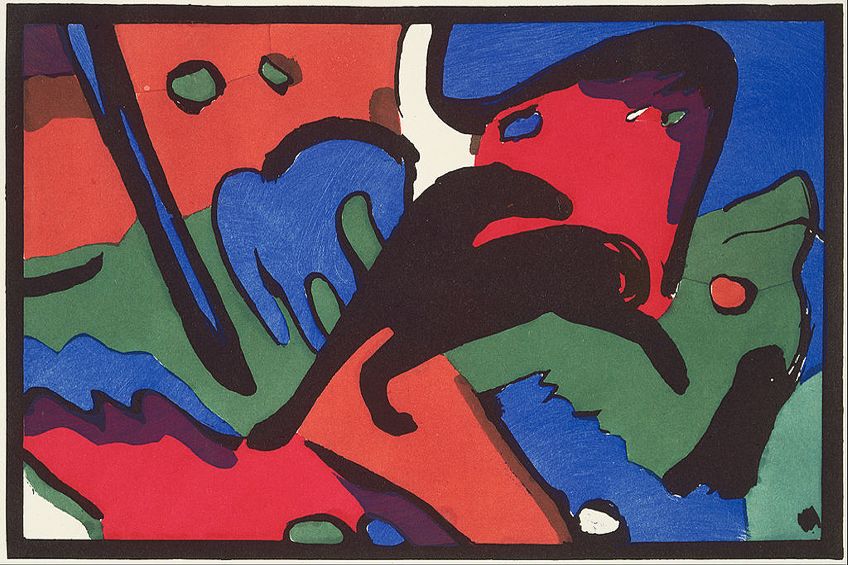 The cover of Franz Marc's and Wassily Kandinsky'due south Der Blaue Reiter, published by R. Piper & Co. in 1912; Museum of Fine Arts, Public domain, via Wikimedia Commons
Kandinsky believed that elementary colors and shapes could help viewers to better perceive the moods and feelings that were nowadays within the paintings, with this theory further encouraging him towards increased utilise of abstraction in his works. For other members of the group, the symbolism of the name became a cardinal tenet when delving deeper into the world of brainchild within the artworks they created.
Unfortunately, merely like Die Brücke, Der Blaue Reiter was a short-lived grouping. Due to the first of World State of war One in 1914, both Marc and Macke were drafted into the German military and were killed shortly after. This forced the remaining members of the group to render habitation, which led to the immediate dissolution of the grouping.
Despite both groups existing for a brief period of fourth dimension, each had a tremendous influence on the Expressionism movement within Frg. Expressionism continued as the dominant artistic mode in Germany post-obit the terminate of the war, with its popularity beginning to fade around 1920.
The movement was later revived during the 1970s in the course of Neo-Expressionism, which spread to the United States and led to the evolution of Figurative Expressionism and Abstract Expressionism.
Famous Expressionist Artists and Their Artworks
Throughout the lifespan of the Expressionist movement, many pregnant artworks were made notable artists, which went on to define the trajectory of the motion. A few of these of import artists accept been listed below, along with their Expressionism painting that remains iconic today.
Edvard Munch (1863 – 1944)
Seen as one of the greatest influences and principal precursors of the Expressionism Motion, Norwegian artist Edvard Munch created frenzied artworks that expressed the anxiety of European individuals due to the recent modernization of society. The late xixthursday century painter emerged as a prominent source of inspiration for other Expressionist artists, as his energetic and emotion-filled artworks created new potential for introspective expression within art.
Prior to Expressionism, Munch was office of the Symbolist movement and created artworks that were heavily influenced by Impressionism and Post-Impressionism. Throughout his career, which spanned nigh lx years, Munch targeted scenes of agony, death, and feet inside his works. He accomplished this through creating plain-featured and emotionally charged portraits, with this style going on to inform the primary characteristics of Expressionism.
The Scream, painted in 1893, exists as his most notable work, also equally one of the most iconic modern artworks in the world. Within his work, Munch depicted the conflict that existed between spirituality and modernity at the time, which became a central theme in his works. This work is based on Munch himself, as it recounts his experience of existence left backside by two of his friends and hearing a shrill scream of nature. Thus, the work portrays the battle that existed between the individual and guild within the mod era.
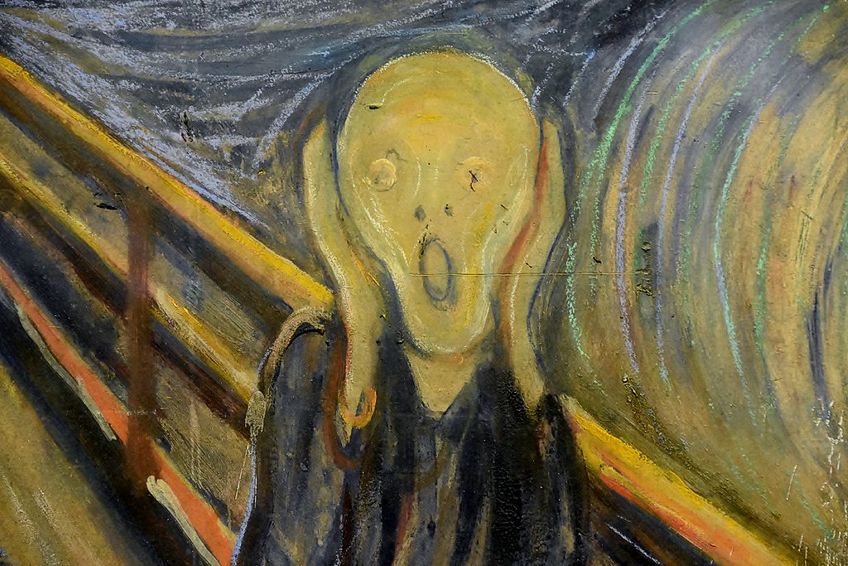 A close-upwards of Edvard Munch'sThe Scream (1893);Richard Mortel from Riyadh, Saudi Arabia, CC Past 2.0, via Wikimedia Commons
This work was inspired by a fleeting moment and was historic for its power to represent the profound feelings of angst and anxiety that filtered into early on modernist society. Munch recalled walking across a bridge in Oslo when the sky turned blood red, which filled him with fear and secured him to the spot before he heard an infinite scream. When viewing the work, one can run across that the scream was felt by the figure, as information technology immerses him completely while simultaneously piercing both the surround and his soul.
The portrayal of Munch'southward emotional response to a scene would go along to course the foundation of the works produced by Expressionists. By the start of 1905, Munch was spending a lot of time in Germany, which put him into directly contact with the movement. There, his themes of alienation in his work developed, which fascinated Expressionist painters and became a central feature inside contemporary art. Today, 2 versions of The Scream exist, with one located at the Munch Museum in Oslo, and the other at the Oslo National Gallery.
Wassily Kandinsky (1866 – 1944)
An of import figure of the Der Blaue Reiter grouping was the Russian Wassily Kandinsky, who founded the group and produced the German Expressionism Art piece that gave the group its name. A pioneer in abstraction inside modern art, Kandinsky went on to create artworks that acted as a span betwixt the Post-Impressionist and Expressionist movements. Due to this, his piece of work went encountered some stylistic changes, every bit it developed from realistic and natural to geometric and abstracted.
Kandinsky'south kickoff and later on most important Expressionist piece of work was painted in 1903 and titled Der Blaue Reiter (The Blue Passenger), which was used equally the name for the Expressionist grouping. This artwork exists as an splendid case of Kandinsky's shift between artistic movements and styles, equally it demonstrates both his Impressionist and Expressionist influences. Impressionism is shown through the techniques and style, while Expressionism is seen through the thick and bold colors, besides as the rough brushstrokes.
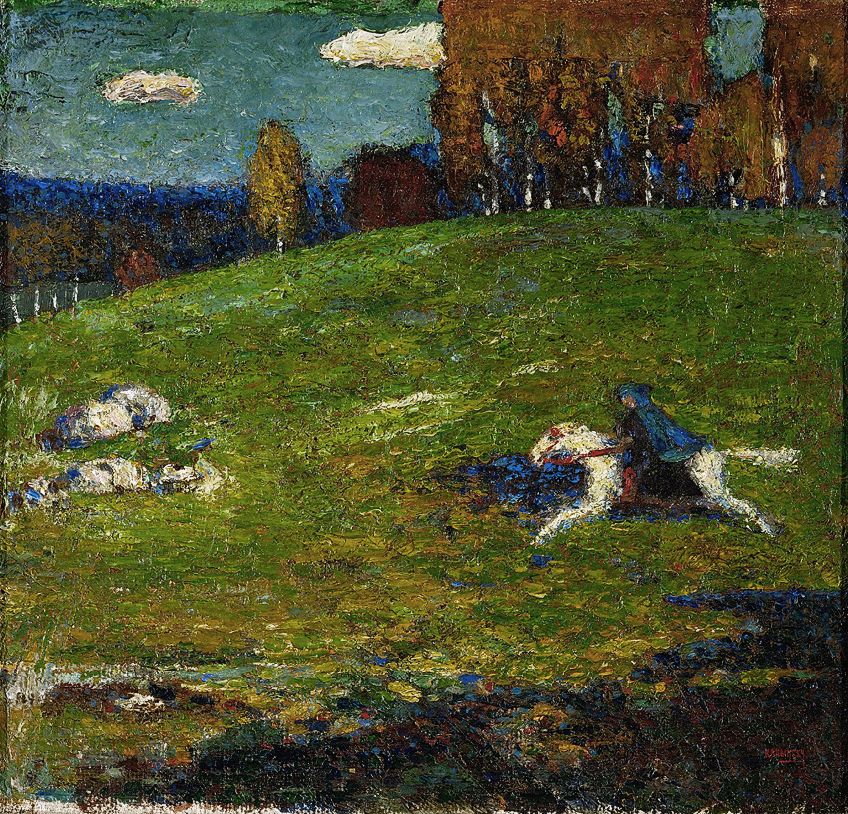 Der Blaue Reiter ('The Blue Rider', 1903) by Wassily Kandinsky;Wassily Kandinsky, Public domain, via Wikimedia Commons
Der Blaue Reiter shows a misleadingly uncomplicated image, every bit a lone horseback passenger dressed in blue is depicted galloping through the fields. Nonetheless, it represents a critical moment in Kandinsky'southward growing pictorial language, as the sun-streaked hillside reveals his interest in contrasting lightness and darkness, in addition to him capturing both stillness and movement inside the same image.
The work's abstracted character invited viewers to interpret the scene, with this sheet becoming the symbol of the expressive possibilities that were welcomed past the advanced Expressionist artists.
Franz Marc (1880 – 1916)
Another founding member of Der Blaue Reiter was German artist Franz Marc, who was fascinated with animals and known for his utilize of brute symbolism inside his artworks. Practicing equally a painter, printmaker, and watercolorist, Marc was a central member of the Expressionist group who gave a deep emotional and psychological significant to the colors he used within his works. Marc made use of the colour blue within his most well-known works, as he believed it to symbolize great masculinity and spirituality.
Marc depicted his brute subjects in a profoundly emotional way, with his work utilizing bright colors in an endeavour to move away from realistic depictions towards a more than spiritual and accurate portrayal of his subjects. Due to the symbolism inside colour, Marc carefully selected his palette to accurately convey the emotive qualities he aimed to limited, and then equally to correctly convey his vision.
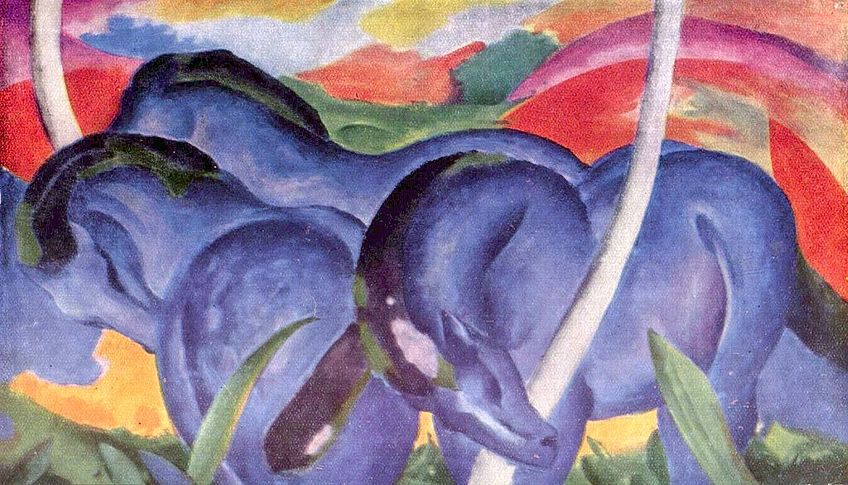 Die großen blauen Pferde ('Large Bluish Horses', 1911) past Franz Marc;Franz Marc, Public domain, via Wikimedia Commons
His most well-known work, painted in 1911, was titled Big Bluish Horses and was shown in the first exhibition put on by Der Blaue Reiter. This artwork featured many brilliant, contrasting primary colors encompassing the principal subject matter, which are 3 blueish horses. The colour of the horses, which was seen as symbolic, along with the soft curvature depicted within their bodies created a feeling of harmony, repose, and remainder against the harsh red of the background and hills.
Marc stated that this noticeable difference demonstrated the contrast that existed between peaceful spirituality and violence, with his serene artwork evoking a sense of superiority. This artwork, which made more than use of more brilliant colors and cubist techniques than some other artworks at the fourth dimension, belonged to a series of works that centered effectually the theme of horses. Marc regarded horses to be symbols of spiritual renewal, hence their prominence within the series he created.
Ernst Ludwig Kirchner (1880 – 1938)
A notable artist belonging to Die Brücke was Ernst Ludwig Kirchner, whose work was typically defined by bold and blocking colors, wide and conflicting brushstrokes, and sharp-edged and athwart forms. Kirchner took inspiration from the works of Postal service-Impressionist artists such as Edvard Munch, which influenced his apply of expressive color within his artworks.
Kirchner was most known for his numerous depictions of Berlin street scenes, with these scenes becoming the well-nigh famous inside his catalog of work. Additionally, his most notable artwork, painted in 1913, came from this street scene category and was titled Street, Berlin. This artwork depicted Kirchner's disdainful outlook on life in Berlin, demonstrated past the extremely sharp brushstrokes and unsettling color contrasts used.
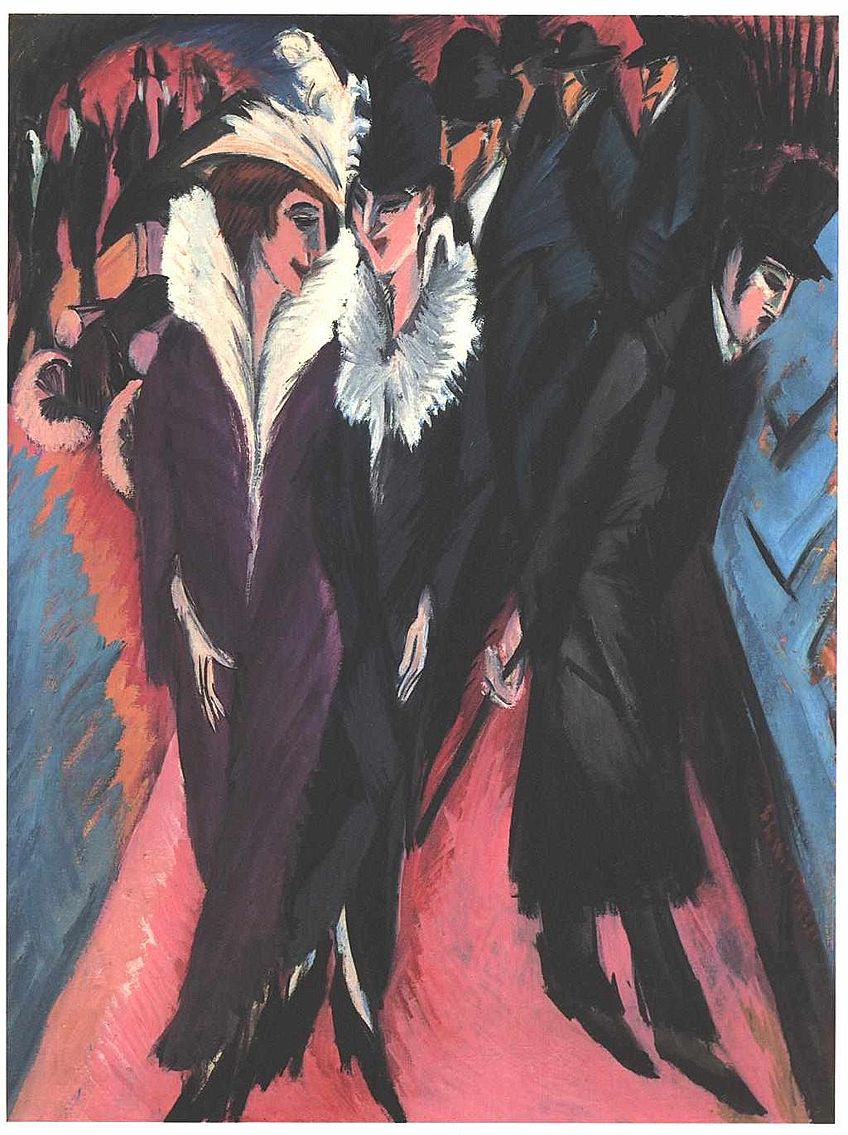 Die Straße ('Street, Berlin', 1913) by Ernst Ludwig Kirchner;Ernst Ludwig Kirchner, Public domain, via Wikimedia Commons
Within this artwork, the faces of the subjects are indistinguishable from each other, which emphasized the empty superficiality of the high life in Berlin. A sense of claustrophobia and confusion is created from the way the figures are standing, every bit the titled ground implies that they are maybe falling out of the painting itself. In doing this, Kirchner created a remarkable portrayal of the alienation that existed in urban settings, which is emphasized through the interchangeability of the figures.
Without regard for a realistic interpretation of the form of the figures, Kirchner made a bold choice in positioning two prostitutes equally the painting's focal point. These two women, too unidentifiable except for their plumbed hats, add to the confusion that is created and the alienation that was innate to modern society due to the sudden loss of spiritual fellowship.
Kirchner emphasized the rapid development of urban culture past depicting individuals who were seen equally simple commodities and prostitutes who were considered worthy subjects.
As a founding fellow member of Die Brücke, Kirchner established a new way of painting that visibly rejected Impressionistic inclinations and the need to accurately portray figures inside paintings. This was demonstrated through his abrupt colors, jagged brushstrokes, and lengthened forms that were adopted by members of Die Brücke so as to change the stylistic traditions of painting.
Karl Schmidt-Rottluff (1884 – 1976)
An additional co-founder of Dice Brücke was Karl Schmidt-Rottluff, whose paintings represented the urban alienation and turmoil that existed within contemporary life at the time. His artworks were ofttimes exaggerated and sharp, with Schmidt-Rottluff reducing the figures and scenes within his works to their simplest forms and then as to produce what he viewed to be authentic expressions.
Afterward Die Brücke began, Schmidt-Rottluff moved to Berlin where he began to pigment portrayals of the city. His nigh well-known work, titled Houses at Night and created in 1912, depicted an abstracted metropolis cake that he had painted. Inside this artwork, Schmidt-Rottluff depicted an unsettlingly empty street with buildings that stagger apart from each other at alarming angles, which was said to conjure up the breach that was nowadays in gimmicky urban society.
The glowing colors of the buildings give off intensity and energy that seems to seep away within the composition, creating an uncomfortable juxtaposition betwixt the bright blocks and the empty street. Additionally, the primitive shape of the buildings permeates the sheet with a pervasive unease and breach, which was depicted equally the essence of modern life within this Expressionist painting.
Oskar Kokoschka (1886 – 1980)
A notable Austrian artist inside the Expressionist move was Oskar Kokoschka, who was best known for his intense Expressionistic landscapes and portraits. While Kokoschka refrained from adopting the techniques and ideologies that trademarked German Expressionism Art, he greatly admired the sense of community that was established between grouping members in their rebellion against traditional art.
His most iconic piece of work was Hans Tietze and Erica Tietze-Conrat, commissioned past the esteemed art historians themselves and was painted in 1909. Kokoschka focused on the inner drama that he saw in his subjects, as demonstrated by the nervous hands that were made into the central point of their anxiety inside this work.
Kokoschka stated that his delineation of the couple was based on how he perceived their psyche as opposed to their physical attributes.
The colorful groundwork and full-bodied brushstrokes of the figures were representative of the techniques used within Expressionism, as well as the heightened emotion that Kokoschka included. Additionally, the swirling and abstracted colors used obscured the background and managed to enclose the subjects in a frenzied and depthless depiction of space within his artwork.
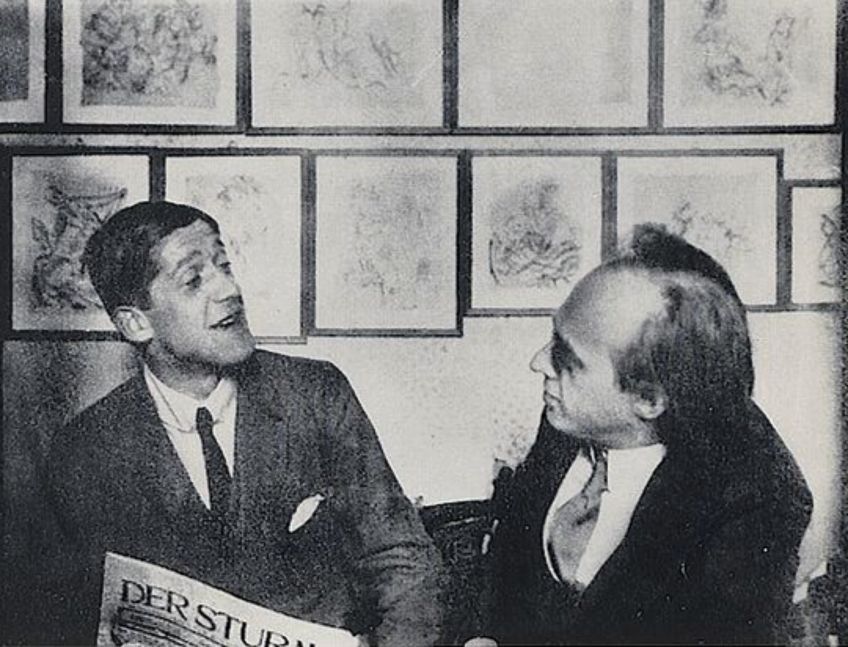 Oskar Kokoschka (left) and Herwarth Walden (right) in the graphics room of Walden'due south flat in Berlin in 1916. Drawings by Kokoschka on the walls;Photographer not credited, Public domain, via Wikimedia Commons
Egon Schiele (1890 – 1918)
In addition to Kokoschka was Egon Schiele, who was another central figure of Austrian Expressionism. Schiele was known for his harsh and often grotesque depictions of undisguised sexuality within his artworks, equally he was influenced by the controversial artistic manner of Gustav Klimt and his iconic painting, The Kiss (1907 – 1908). Displaying such overt eroticism equally a major theme inside his works often got Schiele into problem, as he was imprisoned for indecency in his paintings in 1912.
Still, his altercations with the law did non seem to deter him from his erotic depictions, as he continued to produce paintings with this central theme. Appropriately, Schiele'southward most well-known piece of work, painted in 1917, portrayed this theme and was titled Sitting Woman with Legs Fatigued Upward. Within this artwork, Schiele drew his wife, Edith, who was partially dressed and sitting on the floor with her torso in an unusual position.
Her intense expression assuredly confronts viewers and contradicted the traditional standards of submissive feminine dazzler. Due to this, the portrait is assuming and suggestive, displaying definite themes of eroticism. Edith's fiery ruby-red pilus created a striking dissimilarity with her vibrant green shirt, calculation to the confidence she seemingly possessed. Additionally, her very casual pose managed to create an intimate moment with viewers, demonstrating the emotionality within the work.
Despite beingness blatantly controversial throughout his artistic career, Schiele is withal recognized for the skills he possessed and the emotive quality of his linework and color pick, which placed him decidedly in the Expressionist motion. Thus, Schiele portrayed images exactly as he saw them as opposed to how they appeared to the outside globe.
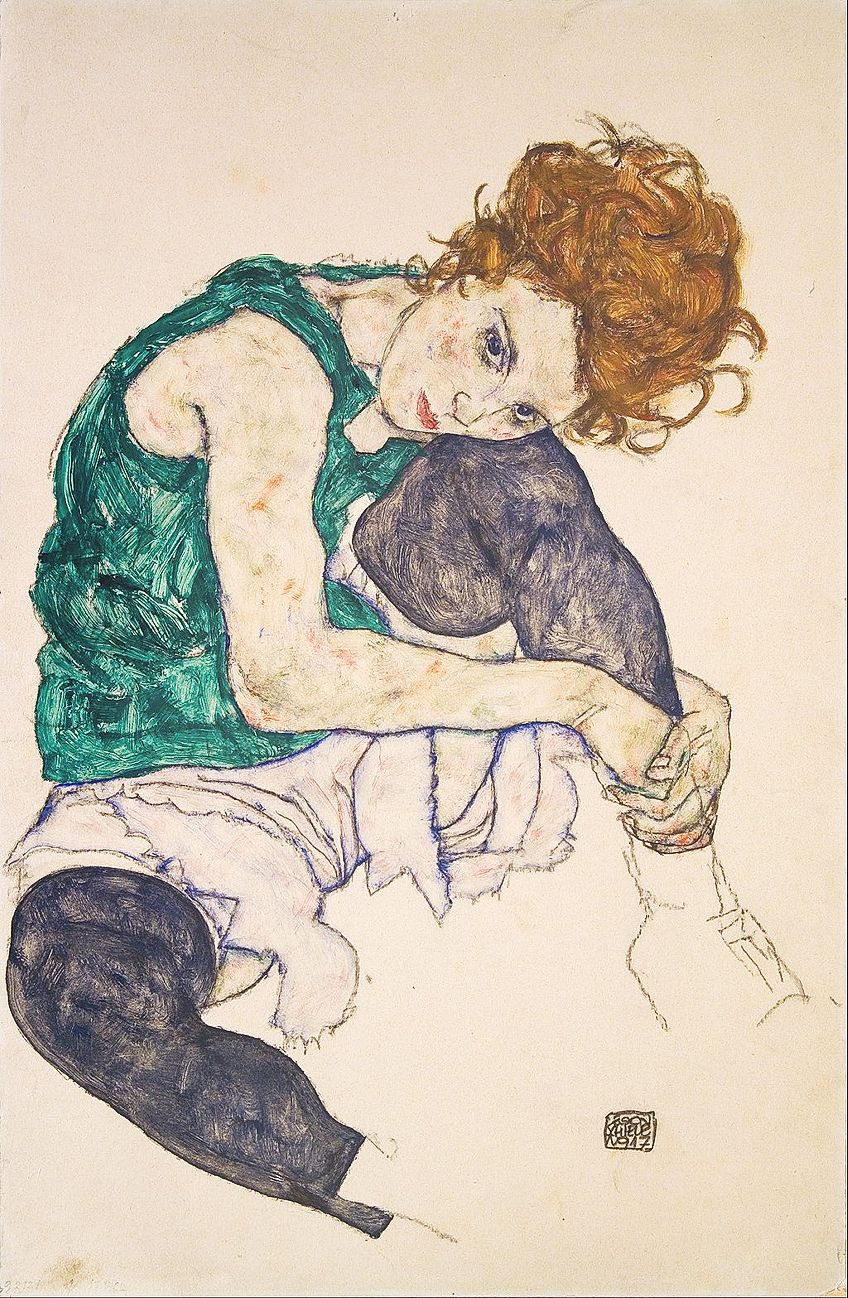 Sitzende Frau mit angezogenem Knie (Adele Herms) (' Seated Woman with Bent Knees (Adele Herms)', 1917) by Egon Schiele;Egon Schiele, Public domain, via Wikimedia Eatables
The Legacy of Expressionism Art
The Expressionist Art movement was indeed revolutionary and wide-ranging, as it went on to inspire diverse adjunct movements and influence the development of contemporary art. The Expressionist movement was not a detached 1, as artists practicing this style experimented with techniques from other movements. This experimentation went on to touch several artistic genres which followed Expressionism, such as Futurism, Cubism, Dadaism, and Surrealism.
Several Expressionists lost their lives during World War One, either from fighting or from trauma or illness as a result of the state of war. Due to this, the movement cruel out of favor within the immediate post-war catamenia and was indefinitely closed by the Nazi dictatorship in 1933. Expressionist artists were labeled every bit degenerates past Nazis and their artworks were taken out of galleries and seized.
However, Expression art paved the way for the evolution of later art movements, with its characteristics nevertheless existing in artistic practices today.
An important avant-garde development of Expression was Abstract Expressionism, originating in the post-war United States during the 1940s and 1950s. In this style, artists explored powerful emotion through the employ of striking colors and aesthetic brushstrokes, as demonstrated in the works of Jackson Pollock. After this, Neo-Expressionism started to develop in the late 1970s and 1980s in reaction to the Conceptual Art and Minimalist art that existed at the time, displaying the far-reaching influence of Expressionism.
Expressionism Art in Other Forms
Due to the rapid expansion of Expressionism Art, this style influenced the development of a variety of other art forms. Of these different forms, the nigh notable artistic spheres where characteristics of Expressionism can exist seen is in movie theater and drama.
Cinema
Within the German Expressionist movement, an important fine art form that adult was German Expressionist Movie house. The reason for its importance is because it was one of the outset artistic genres that had a pregnant impact on the expansion of mod filmmaking, which allowed the development of numerous avant-garde styles that have taken place since and then.
Initially, most Expressionist films were developed due to the alienation that Deutschland experienced leading upwardly to the offset of Globe State of war Ane. All the same, a demand for this experimental picture show genre before long began to grow and by the early 1920s, German Expressionist Cinema had reached an international audience. This led to many European filmmakers playing around with the techniques of Expressionist cinema when producing various films.
After experiencing the horrors caused by the state of war, Expressionist cinema began to blossom. Notable examples of this type of movie theater include The Cabinet of Dr. Caligari, produced in 1920, The Golem: How He Came into the World, produced in 1920, and City, produced in 1927. All three films have a sinister and unsettling undertone, which was said to represent the turmoil and horror that existed within gild after the war had ended.
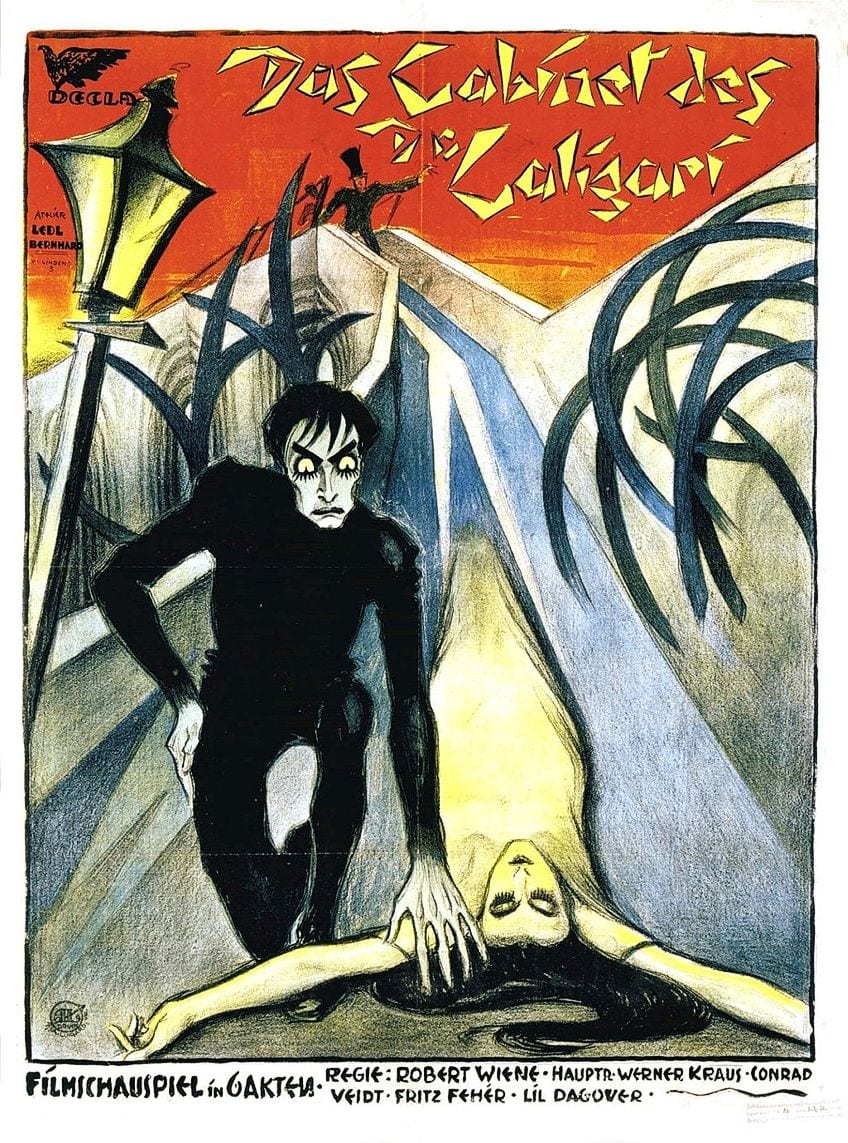 The poster for the film Das Chiffonier des Dr. Caligari ('The Cabinet of Dr. Caligari', 1920);Atelier Ledl Bernhard, Public domain, via Wikimedia Eatables
Drama
The Expressionist movement was a powerful influence on the development of early 20thursday century German theatre, with the near notable playwrights including Ernst Toller and Georg Kaiser. During the 1920s, Expressionism plant its way into the United States where information technology likewise had a significant influence over the theatre there, with this impact leading to the development of early on modernist plays.
In improver to producing visual art, Austrian Oskar Kokoschka was a playwright who wrote what has often been described equally the first Expressionist drama. This play, titled Murderer, The Promise of Women, was written in 1909 and follows the story of an anonymous human and adult female who struggle for authority. Both individuals cause pain, with the human burning the adult female while she stabs and imprisons him. He subsequently frees himself and she dies at his touch. The human being then murders everyone around him and the play ends on an unsettling note.
Expressionist plays often dramatized the spiritual awakenings and sufferings of their protagonists, with some playwrights using an episodic dramatic construction to heighten these emotions which were modeled according to the suffering and death of Jesus. Expressionist dramas also exaggerated the struggle against upper-form values and traditional authority, which was frequently embodied by the father figure within the plays.
Characters within Expressionist plays were simplified to mythic types, choral furnishings, theatrical dialogue that was rhapsodic yet clipped, and elevated intensities. These attributes would go to become characteristics of subsequently Expressionist plays. Additionally, the staging was an of import element within these dramas, as directors chose to forgo the illusion of reality to block actors into a two-dimensional infinite. Notable Expressionist playwrights to come from these developments include Tennessee Williams, Arthur Miller, and Samuel Beckett.
At the beginning of the 20th century, vast shifts in creative styles and ideas broke out in response to the major changes that occurred inside the structure of modern society. Due to the urbanization that occurred, also every bit the outbreak of World State of war One, the perspective of individuals had changed which went on to change their worldview, with artists reflecting the inner turmoil that was beingness experienced. Thus, artists tapped into incredibly raw and true emotions in an effort to portray how the events of the globe had affected guild.
Accept a look at our Expressionism webstory hither!
Summary of the Expressionism Art Movement
What Is Expressionism?
The Expressionist Art movement described artworks that focused on interpreting the intense inner emotions that were experienced by artists and order at the time as opposed to concrete reality. Artists focused their works on depicting these emotions accurately, which were in response to the mass urbanization that had occurred likewise as the showtime of World War I. The Expressionism years spanned from 1905 to effectually 1920.
What Is a Suitable Expressionism Art Definition?
Due to the Expressionism fine art motion existence and then broad, it was somewhat hard to accurately define. Expressionism overlapped with a variety of other movements, with some of these techniques making their way into Expressionism art. Thus, an appropriate definition would be to say that Expressionism art was a movement that valued emotional expression over capturing realism inside artworks.
Which Painters Were Well-Known Within the Expressionism Fine art Motion?
Important artists of the movement were Wassily Kandinsky, Ernst Ludwig Kirchner, Franz Marc, Karl Schmidt-Rottluff, Oskar Kokoschka, and Egon Schiele. Additionally, 2 important precursors to the movement were Edvard Munch and Vincent van Gogh.
What Creative Groups Developed in Response to Expressionism Within Art?
Within the Expressionist motion, German Expression developed in Berlin. The two groups falling nether this movement were known as Dice Brücke (1905 – 1913) and Der Blaue Reiter (1911 – 1914).
Source: https://artincontext.org/expressionism-art/
0 Response to "Introduced the Popular Use of the Term Expressionism to Describe Art With Strongly Emotional Content"
Post a Comment