Is the Charter of Will on Dool Being Written Out Again? Is Will Going T O Die?
past David Pilgrim, Curator, Jim Crow Museum
As for me, I raced effectually the dumpsters collecting discarded "White" and "Colored" signs, thinking they would exist some interest to posterity in a Museum of Horrors. --Stetson Kennedy one
I am a garbage collector, racist garbage. For iii decades I have collected items that defame and belittle Africans and their American descendants. I have a parlor game, "72 Pictured Party Stunts," from the 1930s. Ane of the game'due south cards instructs players to, "Go through the motions of a colored boy eating watermelon." The carte shows a dark black boy, with bulging eyes and blood cherry lips, eating a watermelon equally big as he is. The bill of fare offends me, but I collected it and 4,000 similar items that portray blacks as Coons, Toms, Sambos, Mammies, Picaninnies, and other dehumanizing racial caricatures. I collect this garbage considering I believe, and know to be true, that items of intolerance can be used to teach tolerance.
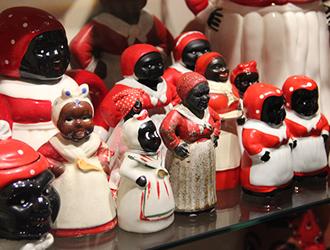
I bought my first racist object when I was 12 or xiii. My memory of that upshot is non perfect. It was the early 1970s in Mobile, Alabama, the dwelling of my youth. The detail was modest, probably a Mammy saltshaker. It must have been cheap because I never had much coin. And, it must take been ugly because after I paid the dealer I threw the detail to the ground, shattering information technology. It was not a political act; I, simply, hated it, if you tin can hate an object. I do non know if he scolded me, he almost certainly did. I was what folks in Mobile, blacks and whites, indelicately referred to as a "Cerise Nigger." In those days, in that identify, he could take thrown that proper noun at me, without incident. I do non call back what he called me, but I am certain he called me something other than David Pilgrim.
I have a 1916 magazine advertisement that shows a fiddling black male child, softly caricatured, drinking from an ink canteen. The bottom explanation reads, "Nigger Milk." I bought the print in 1988 from an antique store in LaPorte, Indiana. It was framed and offered for sale at $twenty. The salesclerk wrote, "Black Impress," on the receipt. I told her to write, "Nigger Milk Print."

"If you are going to sell information technology, phone call information technology by its proper noun," I told her. She refused. Nosotros argued. I bought the print and left. That was my final argument with a dealer or sales clerk; today, I purchase the items and leave with little conversation.
The Mammy saltshaker and the "Nigger Milk" print are not the virtually offensive items that I take seen. In 1874, McLoughlin Brothers of New York manufactured a puzzle game called "Chopped Up Niggers." Today, the game is a prized collectible. I have twice seen the game for auction; neither time did I have the $3,000 necessary to buy information technology. At that place are postcards from the get-go one-half of the 20th century that show blacks being whipped, or worse, hanging dead from trees, or lying on the ground burned across recognition. Postcards and photographs of lynched blacks sell for around $400 each on eBay and other Internet auction houses. I can afford to purchase one, but I am not set up, not withal.
My friends claim that I am obsessed with racist objects. If they are correct, the obsession began while I was an undergraduate student at Jarvis Christian College, a minor historically black institution in Hawkins, Texas. The teachers taught more than scientific principles and mathematical equations. I learned from them what it was like to live as a blackness human being under Jim Crow segregation. Imagine being a college professor but having to habiliment a chauffeur's chapeau while driving your new auto through minor towns, lest some disgruntled white man crush you for existence "uppity." The stories I heard were non aroused ones; no, worse, they were matter-of-fact accounts of everyday life in a state where every blackness person was considered inferior to every white one, a time when "social equality" was a profane expression, fighting words. Blacks knew their clothing sizes. Why? They were not allowed to attempt on clothes in department stores. If blacks and whites wore the same clothes, even for a curt while, it implied social equality, and, perhaps, intimacy.
I was 10 years sometime when Martin Luther Rex, Jr. was killed; we watched the funeral on a modest blackness and white tv set in my fifth grade class at Bessie C. Fonville Simple. All my classmates were black; Mobile was proudly, defiantly segregated. Two years later, in search for a cheaper house, my family moved to Prichard, Alabama, a small adjoining metropolis that was even more than segregated. Less than a decade earlier, blacks had non been allowed to use the Prichard City Library -- unless they had a note from a white person. Whites owned most of the stores. Whites held all the elected offices. I was part of the class that integrated Prichard Middle School. A local boob tube commentator called information technology an "invasion." Invaders? We were children. We fought adult whites on the fashion to school and white children at school. Past the time I graduated from Mattie T. Blount High School most of the whites had left the city. When I arrived at Jarvis Christian College I was not naive near southern race relations.
My college teachers taught the usual lessons well-nigh Frederick Douglass, Sojourner Truth, Booker T. Washington, and W.E.B. Dubois. More than importantly, they taught nearly the daily heroism of the maids, butlers, and sharecroppers who risked their jobs, and sometimes their lives, to protestation Jim Crow segregation. I learned to read history critically, from the "lesser-upward," not as a linear critique of so-chosen great men, but from the viewpoint of oppressed people. I realized the great debt that I owed to the blacks -- all but a few forgotten past history -- who suffered so that I could be educated. It was at Jarvis Christian Higher that I learned that a scholar could exist an activist, indeed, must be. Hither, I first had the thought of building a drove of racist objects. I was non sure what I would practise with it.
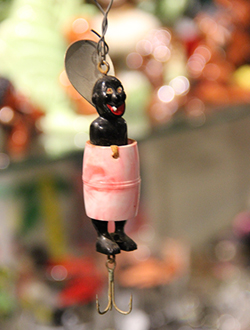
All racial groups take been caricatured in this state, just none have been caricatured as frequently or in equally many means as accept black Americans. Blacks take been portrayed in popular culture as pitiable exotics, cannibalistic savages, hypersexual deviants, childlike buffoons, obedient servants, self-loathing victims, and menaces to society. These anti-black depictions were routinely manifested in or on material objects: ashtrays, drinking glasses, banks, games, fishing lures, detergent boxes, and other everyday items. These objects, with racist representations, both reflected and shaped attitudes towards African Americans. Robbin Henderson (Faulkner, Henderson, Fabry, & Miller, 1982), managing director of the Berkeley Art Centre, said, "derogatory imagery enables people to absorb stereotypes; which in plow allows them to ignore and disregard injustice, bigotry, segregation, and racism" (p. 11). She was right. Racist imagery is propaganda and that propaganda was used to back up Jim Crow laws and community.
Jim Crow was more than a series of "Whites Only" signs. It was a style of life that approximated a racial degree system (Woodward, 1974). Jim Crow laws and etiquette were aided by millions of material objects that portrayed blacks as laughable, detestable inferiors. The Coon extravaganza, for case, depicted blackness men every bit lazy, easily frightened, chronically idle, inarticulate, physically ugly idiots. This distorted representation of blackness men found its fashion onto postcards, canvass music, children'south games, and many other textile objects. The Coon and other stereotypical images of blacks buttressed the view that blacks were unfit to attend racially integrated schools, live in safe neighborhoods, piece of work in responsible jobs, vote, and concur public role. With little effort I can hear the voices of my black elders -- parents, neighbors, teachers -- demanding, almost pleading, "Don't be Coon, exist a man." Living under Jim Crow meant battling shame.
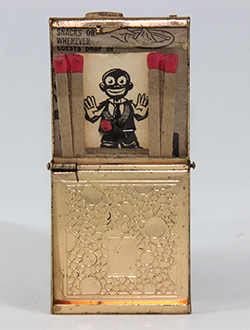
I nerveless many racist objects during my four years as a graduate pupil at The Ohio Land University. Nearly of the items were pocket-sized and cheap. I paid $2 for a postcard that showed a terrified blackness man being eaten by an alligator. I paid $5 for a matchbox that showed a Sambo-like grapheme with oversized genitalia. The collection that I amassed was not a sample of what existed in Ohio -- or anywhere; it was, instead, a sample of what I could afford. Brutally racist items were, and remain, the most expensive "black collectibles." In Orrville, Ohio, I saw a framed print showing naked black children climbing a fence to enter a swimming hole. The caption read, "Last One In'south A Nigger." I did not have the $125 to buy it. That was the early 1980s, a few years before the prices for racist collectibles escalated. Today, that print, if accurate, sells for several 1000 dollars. On vacation, I scoured flea markets and antiquarian stores from Ohio to Alabama, looking for items that denigrated black people.
My years at The Ohio State University were, I realize now, filled with much anger. I suppose every sane black person must be aroused, at least for a while. I was in the Folklore Department, a politically liberal department, and talk most improving race relations was common. There were 5 or half dozen black students, and we clung together similar frightened outsiders. I will not speak for my black colleagues, merely I was sincerely doubtful of my white professors' understanding of everyday racism. Their lectures were often brilliant, but never complete. Race relations were fodder for theoretical argue; blacks were a "enquiry category." Real blacks, with real ambitions and bug, were problematic. I was suspicious of my white teachers and they reciprocated.
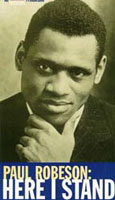
A friend suggested that I take some of my "elective courses" in the Black Studies Program. I did. James Upton, a Political Scientist, introduced me to Paul Robeson'due south book Here I Stand (1958). Robeson, an accomplished athlete and entertainer, was as well an activist who believed that American capitalism was pernicious and detrimental to poor people, especially blackness Americans. Robeson maintained his political convictions despite ostracism and outright persecution. I was not anti-capitalism, only I admired his willingness to follow his political convictions -- and his unwavering fight for the rights of oppressed people. I read many books about race and race relations simply few had every bit much impact on me every bit Here I Stand. I read James Baldwin's novels and essays. His anger establish a willing ear, only I was troubled by his homosexuality. That is inappreciably surprising. I was reared in a community that was demonstratively homophobic. Homosexuality was seen as weakness, and "sissies" were "bad luck." White bigots do not take a monopoly on ignorance. Progressiveness is a journey. I had a long fashion to become.
I have long felt that Americans, especially whites, would rather talk about slavery than Jim Crow. All ex-slaves are expressionless. They do non walk among united states of america, their presence a reminder of that unspeakably cruel system. Their children are dead. Distanced by a century and a one-half, the modern American sees slavery equally a regrettable menses when blacks worked without wages. Slavery was, of course, much worse. Information technology was the complete domination of one people by another people -- with the expected abuses that accompany unchecked power. Slavers whipped slaves who displeased them. Clergy preached that slavery was the will of God. Scientists "proved" that blacks were less evolved, a subspecies of the human race and politicians agreed. Teachers taught young children that blacks were inherently less intelligent. Laws forbade slaves, and sometimes costless blacks, from learning to read and write, possessing money, and arguing with whites. Slaves were holding -- thinking, suffering holding. The passing of a century and a one-half affords the typical American enough "psychological space" to bargain with slavery; when that is not sufficient, a sanitized version of slavery is embraced.
The horrors of Jim Crow are not and then easily ignored. The children of Jim Crow walk among u.s., and they have stories to tell. They think Emmett Till, murdered in 1955, for an interchange with a white adult female. Long earlier the tragic bombings of September 11, 2001, blacks who lived under Jim Crow were acquainted with terrorism. On Sun, September 15, 1963, the Sixteenth Street Baptist Church, a black church in Birmingham, Alabama was bombed. Twenty-three people were hurt, and four girls were killed. The blacks who grew up during the Jim Crow catamenia can tell you well-nigh this bombing -- and many others. Blacks who dared protest the indignities of Jim Crow were threatened, and when the threats did not piece of work, subjected to violence, including bombings. The children of Jim Crow tin talk about the Scottsboro boys, the Tuskegee Experiment, lynchings, and the bump-off of Martin Luther Male monarch, Jr. and they have stories about the daily indignities that befell blacks who lived in towns where they were not respected or wanted.
Yes, many of united states of america would rather talk about slavery than Jim Crow because a discussion of Jim Crow begs the question: "What virtually today?"
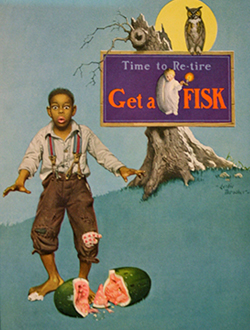
In 1990 I joined the sociology faculty at Ferris State University in Big Rapids, Michigan. It was my second education position and my third "real" job. At that fourth dimension, my collection of racist artifacts numbered more than ane,000. I kept the collection in my home, bringing out pieces when I gave public addresses, mainly to high school students. I discovered that many young people, blacks and whites, were not merely ignorant most historical expressions of racism, but they believed that I was exaggerating when I described the awfulness of Jim Crow. Their ignorance disappointed me. I showed them segregation signs, Ku Klux Klan robes, and everyday objects that portrayed blacks with ragged apparel, unkempt hair, jutting eyes, and clown-similar lips -- running toward fried craven and watermelons and running away from alligators. I talked to the students about the connection betwixt Jim Crow laws and racist material objects. I was too heavy-handed, too driven to brand them sympathize; I was, that is, learning to employ the objects as teaching tools -- while, simultaneously, dealing with my acrimony.
A seminal event occurred in 1991. A colleague told me nigh an elderly black woman who had a big collection of black-related objects. I will call her Mrs. Haley. She was an antique dealer in a small Indiana town. I visited her and told her nigh my collection. She seemed unimpressed. I described how I used the racist objects to teach students virtually racism. Again, she was not impressed. Her store displayed a few pieces of racist memorabilia. I asked if she kept most of the "blackness textile" at her habitation. She said that she kept those pieces in the dorsum, but I could only come across them if I agreed to a condition, namely, I could never "pester" her to sell me any of the objects. I agreed. She locked the front door, put the "closed" sign in the window, and motioned for me to follow her.
If I live to exist 100 I volition never forget the feeling that I had when I saw her drove; it was sadness, a thick, common cold sadness. In that location were hundreds, peradventure thousands, of objects, side-by-side, on shelves that reached to the ceiling. All iv walls were covered with some of the most racist objects imaginable. I owned some of the objects, others I had seen in Black Memorabilia price guides, and others were and so rare I accept non seen them since. I was stunned. Sadness. It was as if I could hear the pieces talking, yowling. Every conceivable distortion of black people, our people, was on display. It was a sleeping accommodation of horrors. She did not talk. She stared at me; I stared at the objects. I was a life-sized wooden figure of a black man, grotesquely caricatured. It was a testament to the creative energy that ofttimes lurks behind racism. On her walls was a textile record of all the injure and damage done to Africans and their American descendants. I wanted to cry. It was at that moment that I decided to create a museum.
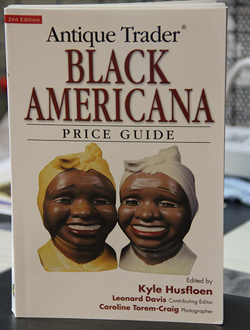
I visited her often. She liked me because I was "from downwards abode." She told me that in the 1960s and 1970s many whites gave her racist objects. They did not want to be identified with racism. They were embarrassed. That sentiment changed in the mid-1980s. Several cost guides devoted solely to racist collectibles were published. The price guides helped create the contemporary marketplace for racist collectibles. Each new price guide showed prices escalating, and a national pursuit of racist items ensued. Mrs. Haley'south drove was worth hundreds of thousands of dollars, simply she had no desire to sell the pieces. They were our by, America'due south past. "We mustn't forget, babe," she said, without even a hint of anger. I stopped visiting afterwards a twelvemonth or so, she died, and I heard that her drove was sold to private dealers. That broke my center on several levels. It bothers me that she did non live to run into the museum she helped inspire.
I continued to collect racist objects: musical records with racist themes, angling lures with Sambo imagery, children's games that showed naked, dirty black children -- any and every racist detail that I could afford. In the cold months I bought from antiquarian stores; in the warmer months, I traveled to flea markets. I was impatient. I sought to purchase unabridged collections from dealers and collectors. Once more, limited finances restricted me to purchasing only small collections.
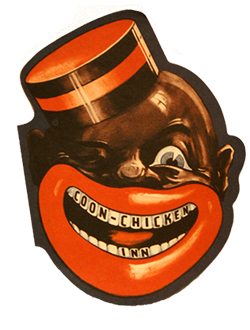
In 1994 I was office of a three-person team from Ferris State University that attended a 2-week workshop at Colorado College, in Colorado Springs. The briefing, sponsored by the Lilly Foundation, was devoted to the liberal arts. The charge to our squad was to introduce "diversity" into the general teaching curriculum at Ferris Land University. I traveled with Mary Murnik, a colleague, to all the local antique stores. Colorado Springs is a politically conservative urban center, not surprisingly, in that location were many racist items for sale -- some vintage, many reproductions. I bought several segregation signs, a Coon Chicken Inn glass, three racist ashtrays, and many other items. I also bought several 1920s records, all with racist themes, from a dealer who tried to talk most "the trouble with colored people." I wanted the records; I did not want the chat. John Thorp, the other fellow member of the team, and I spent hours planning a strategy to convince the Ferris Country University administration to requite concrete space and money to a room that would house my racist collectibles. It took several years but he and I were successful.
Today, I am the founder and curator of the Jim Crow Museum of Racist Memorabilia at Ferris Country University. Most collectors are soothed by their collections; I hated mine and was relieved to get it out of my home. I donated my entire collection to the university, with the condition that the objects would be displayed and preserved. I never liked having the objects in my home. I had small children. They would wander to the basement and await at "daddy's dolls" -- two mannequins dressed in full Ku Klux Klan regalia. They played with the racist target games. One of them, I do not know which, broke a "Tom" cookie jar. I was angry for two days. The irony is non lost to me.
The museum will part equally a teaching laboratory. Ferris State Academy faculty and students use the museum to sympathize historical expressions of racism. The museum also includes items created after the Jim Crow period ended; this is a valuable addition considering also many students were dismissing racism as a "thing of the past." Scholars conducting research, mainly social scientists, also visit the museum. Only rarely are children allowed in the room, and adults -- preferably their parents -- are encouraged to back-trail them. We encourage all visitors to sentry Marlon Rigg'due south documentary, Ethnic Notions (Riggs, 1987) or Jim Crow'due south Museum (Pilgrim & Rye, 2004), a documentary I produced and Clayton Rye directed before entering the room. A trained museum facilitator is at that place for all tours. Clergy, civil rights groups and human rights organizations as well visit the museum.
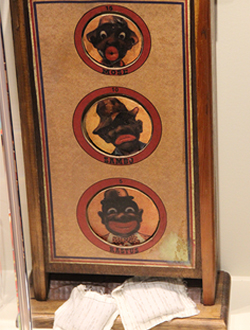
The mission of the Jim Crow Museum is straightforward: use items of intolerance to teach tolerance. Nosotros examine the historical patterns of race relations and the origins and consequences of racist depictions. The aim is to engage visitors in open up and honest dialogues about this country's racial history. We are not afraid to talk about race and racism; we are afraid not to. I continue to deliver public presentations at high schools and colleges. Race relations endure when discussions of race and racism are verboten. High schools that "sincerely" include race, racism, and diversity in their curriculums increase tolerance for others. It is relatively easy to identify those high schools that are afraid or unwilling to honestly examine race and racism. There y'all will find a 1950s-like pattern of everyday race relations. Racial stereotypes volition dominate, though they may go unspoken. Inevitably, there will be a "racial incident," -- a racial slur hurled, a fight blamed on "the other," -- and at that place will exist no relevant foundation laid for dealing with the problem, other than hiring me or a similar "multifariousness consultant" to restore order. The Jim Crow Museum is founded on the belief that open up, honest, even painful discussions about race are necessary to avoid yesterday'due south mistakes.
Our goal is not to shock visitors. A thick naivet'e well-nigh America's past permeates this country. Many Americans understand historical racism mainly every bit a general brainchild: Racism existed; information technology was bad, though probably not as bad as blacks and other minorities claim. A confrontation with the visual evidence of racism -- especially thousands of items in a pocket-size room -- is frequently shocking, even painful. In the tardily 1800s traveling carnivals and amusement parks sometimes included a game called "Hit the Coon." A black man would stick his head through a pigsty in a painted canvas; the background was a plantation scene. White patrons would throw assurance -- and in especially brutal instances, rocks -- at the black homo's caput to win prizes. A person living in the 21st century who sees that banner or a reproduction gets a glimpse of what it was like to be a black man in the early years of Jim Crow.
That funfair banner reinforced the idea that blacks were non equally human as whites. It alleviated white guilt near blackness pain; information technology suggested that blacks did not experience hurting the way normal people -- whites -- experienced hurting. It helped legitimize "happy violence" directed against blacks. Information technology functioned as an ego boost for the white hurlers. How many poorly paid, socially marginalized whites expressed their frustration at the expense of "black heads?" The "Hit the Coon" game and its cousin, "African Dodger," were eventually replaced with target games that used wooden black heads. You do not have to exist a psychologist to understand the symbolic violence. Not coincidentally, games that used blacks as targets were popular when the lynching of existent blacks was increasing in frequency. The Jim Crow Museum has many objects that show blacks existence thrown at, hitting, or beaten. We do not accept the carnival banner -- only I could teach a lot with ane.
Some truths are painful
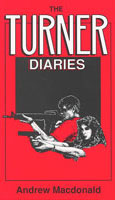
Anger is a necessary leg on many journeys, but it cannot be the destination. My anger reached its apex when I read The Turner Diaries (1978), written by William Fifty. Pierce, penname Andrew MacDonald.2 The book chronicles the "heroism" of white supremacists who overthrow the federal regime, win a bloody race war, and establish a social lodge where whites rule. Blacks, other minorities, and the whites who back up them are brutally, graphically killed. This book, arguably the most racist book produced in the second half of the 20th century, has influenced numerous racist organizations, including The Social club and The Aryan Republican Army. Timothy McVeigh, convicted of the 1995 bombing of the Federal Building in Oklahoma City, was a fan of the book -- and his bombing was eerily similar to bombings described in The Turner Diaries. I made the mistake of reading it -- all 80,000 words -- in one 24-hour interval, while I was tired. It consumed me.
Pierce, who holds a Ph.D. in physics from the Academy of Colorado, bonded with Nazis in the 1960s. That explains why he wrote the book, but why did it anger me then much? I had, after all, a basement full of racist memorabilia. I was raised in the segregated South. I call up the race riots on Davis Avenue in Mobile, Alabama. I was familiar with the many means that you lot tin call me a nigger and threaten to hurt me. The ideas in Pierce's volume, though venomous, were not new to me. Nevertheless, that book shook me.
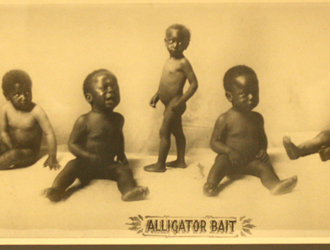
Almost that time, I took a colleague's students into the Jim Crow Museum. I showed them the ugliness, the Mammy, the Sambo, the Brute, the caricatured sores foisted on blackness Americans. I showed them. Showed information technology all. And we went deep, deeper than ever before, deeper than I meant to become. My acrimony showed. Afterwards 3 hours they left, all merely two -- a young black woman and a eye-anile white man. The adult female sat, paralyzed, transfixed, and stunned before a picture of 4 naked black children. The children sat on a riverbank. At the lesser of the picture were these words: "Alligator Bait." She saturday there, watching it, trying to understand the manus that had made it, the mind that conceived it. She did not say a word, just her eyes, her pout, the hand at her forehead all said, "Why, sugariness Jesus, why?" The white human stopped staring at the items and stared at me. He was crying. Not a sob, a single tear stream. His tears moved me. I walked toward him. Before I could talk, he said, "I am distressing, Mr. Pilgrim. Delight forgive me."
He had not created the racist objects in the room, simply he had benefited from living in a society where blacks were oppressed. Racial healing follows sincere contrition. I never realized how much I needed to hear some white person, any sincere white person, say, "I am sorry, forgive me." I wanted and needed an apology -- a heartfelt i that changes two lives. His words took the steam out of my anger. The Jim Crow Museum was not created to stupor, shame, or acrimony, but to lead to a deeper understanding of the historical racial divide. Some visitors to the museum say that I seemed so detached; I am not, I have struggled to harness my anger and channel it into productive work.
Virtually people who visit the Jim Crow Museum understand our mission, accept our methods, and continue the journey toward understanding and improving race relations. Just we have critics. That is to be expected. The 21st century has brought a fear and unwillingness to expect at racism in a deep, systematic style. The hedonistic desire to avert hurting (or anything uncomfortable) is counter to our method of directly confronting the ugly legacy of racism. Moreover, there is a growing want among many Americans to forget the past and movement forward. "If we just stop talking well-nigh historical racism, racism will become abroad." It is not that easy. We may not talk openly near race, only that is not the aforementioned as forgetting it. America remains a nation residentially segregated by race. Our churches, temples, and synagogues are, in the primary, racially divided. Old patterns of racial segregation accept returned to many public schools. Race matters. Racial stereotypes, sometimes yelled, sometimes whispered, are common. Overt racism has morphed into institutional racism, symbolic racism, and everyday racialism. Attitudes and beliefs about race inform many of our decisions, large and small. "Allow's stop talking about information technology," is a plea for comfort -- a comfort denied to blacks and other minorities. The way to move forward is to confront the historical and the contemporary expressions of racism, and to do and then in a setting where attitudes, values, and behaviors are critiqued.
Several visitors to the museum take asked, "Why don't y'all take any positive items in hither?" My respond is simple: we are, in effect, a blackness holocaust museum. I mean no disrespect to the millions of Jews and others who died at the hands of the maniacal Adolf Hitler and his followers. I hesitate to use the give-and-take "holocaust" to depict the experiences of Africans and their American descendants because I do not desire to trivialize the suffering of Jews -- nor do I want to compare victimizations. Only what word should I use? Thousands of Africans died during the Trans-Atlantic slave voyage. Many more than lived nether the brutal system of slavery, and even afterwards slavery was officially ended thousands of blacks were lynched -- many ritualistically, by white mobs. We have today many modest "white towns" that were created because the blacks were "driven out," victims of wanton racial violence.

When the Jim Crow Museum moves into a larger facility three additional "stories" volition be told. Artifacts and signage will introduce visitors to the wonderful accomplishments of black scholars, scientists, artists, and inventors who thrived despite living under Jim Crow. Also, a "Civil Rights Movement" department will be added. There, visitors will find images of protestors, with signs saying, "I, Too, Am A Man." Visitors will learn near ceremonious rights workers, many of whom are non found in history books. This department can be conceptualized as a "Death of Jim Crow" period, though vestiges of Jim Crow era thinking remain. Finally, there will be a room of reflection. I envision a mural of civil rights martyrs, from all races, surrounding visitors as they enquire the important question, "What tin I do today to accost racism?" These will be positive sections. We also plan to enlarge photographs of blacks existence "regular" people: eating, walking, studying or simply living. These affiche-sized images will be placed near the caricatured objects then that visitors remember that the thousands of objects that denigrate blacks are distortions, mean-spirited exaggerations -- they are not realistic depictions. There will be several kiosks with stories from people who lived under Jim Crow.
Jim Crow was wounded in the 1950s and 1960s. The Supreme Courtroom decision, Brown five. Lath of Education of Topeka (1954) ruled segregated schools unconstitutional. This hastened the end of legal segregation, but it did not end it, as evidenced past the demand for the Civil Rights Movement. Whites, peculiarly northerners, were confronted with images of black protestors being beaten by police officers, attacked by police force dogs, and arrested for trying to vote, swallow at segregated lunch counters, and attend "white" schools. The 1964 Civil Rights Deed, passed after (and perhaps because of) President John F. Kennedy's death, was certainly a accident to Jim Crow.
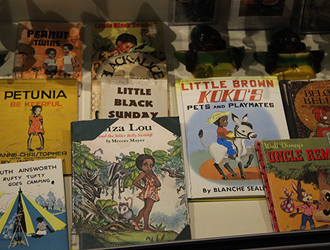
I by one segregation laws were removed in the 1960s and 1970s. The emptying of legal barriers to voting led to the election of black politicians in many cities, including onetime bastions of segregation such as Birmingham and Atlanta. From this period forrad, white colleges and universities in the South admitted blackness students, and hired black professors, albeit often a token number. Affirmative action programs forced employers in both the public and individual sectors to hire blacks and other minorities. Some blacks appeared on tv set shows in non-stereotypical means. Significant racial issues remained only it seemed that Jim Crow era attitudes and behaviors were destined to die. Many whites destroyed their household items that defamed black people, for instance, ashtrays with smile Sambos, "Jolly Nigger" banks, sheet music with titles like "Coon, Coon, Coon," and children' due south books like Picayune Black Sambo.
Jim Crow attitudes did non die; and in many instances, have resurfaced. The end of the 20th century institute many whites resentful of the "gains" by blacks. Affirmative Activity policies were attacked equally reverse discrimination against whites. The slavery-era Coon caricature of blacks as lazy, ne'er-exercise-wells re-emerged as a depiction of modern welfare recipients. White Americans back up welfare for the "deserving poor," but strongly oppose it for persons perceived as lazy and unwilling to work. Black welfare recipients are seen as indolent parasites. The centuries-former fear of blacks, especially young blackness males, as brutes found new life in gimmicky portrayals of blacks as thugs, gangsters, and menaces to society.
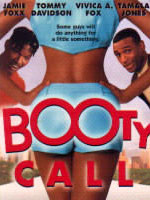
Black entertainers who capitalize financially on white America'due south acceptance of anti-black stereotypes perpetuate many of these images. In popular and material culture, the Mammy portrayal of black women was replaced by the Jezebel image: black women as hypersexual deviants. The racial sensitivity that had been promoted in the 1970s and 1980s was by the cease of the century derided as "political correctness."
The new racial climate is marked by ambivalence and contradiction. Most polls about race show a pass up in prejudice among whites. There remains a heightened sense that racism is wrong and that tolerating "racial others" is good; however, in that location is a growing credence of ideas critical of and analytical toward blacks and other minorities. Many whites are tired of talking most race, believing that America has made enough "concessions" to its black citizens. Some are rebelling against authorities intrusion, arguing that the authorities, especially the federal government, does not have the right to strength integration. Still others wage personal battles against political correctness. And so at that place is that segment of the white population that however believes that blacks are less intelligent, less ambitious, less moral, and more given to social pathological behaviors: drug abuse, sexual deviance, and crimes against property and persons. Martin Luther King, Jr., vilified during his life, is hailed as a hero; blacks as a whole are viewed with suspicion, sometimes alarm.
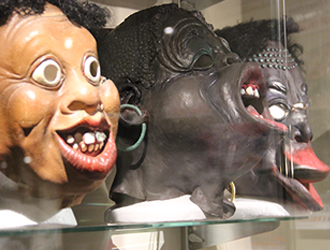
In the early 1990s I attended an academic conference in New Orleans. I searched local stores for racist objects. There were not many. Ten years after I returned to New Orleans. I plant anti-blackness objects in many stores. This is disappointing only not surprising. Brutally racist items are readily bachelor through Cyberspace sale houses, about notably eBay. Indeed, practically every detail housed in the Jim Crow Museum is being sold on some Internet site. Old racist items are being reproduced and new items are being created. Each year, Halloween USA produces monster masks past exaggerating the features of Africans and African Americans.
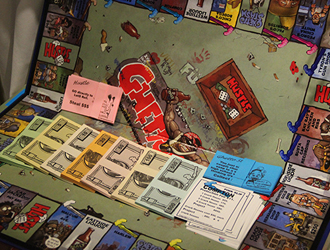
In 2003, David Chang created a national uproar with his game, Ghettopoly. Unlike Monopoly, the popular family game, Ghettopoly debases and belittles racial minorities, especially blacks. Ghettopoly has 7 game pieces: Pimp, Hoe, 40 oz, Car Gun, Marijuana Foliage, Basketball, and Scissure. One of the game's cards reads, "You lot got yo whole neighborhood addicted to crack. Collect $50 from each playa." Monopoly has houses and hotels; Ghettopoly has crack houses and projects. The distributors advertise Ghettopoly this way: "Buying stolen properties, pimpin hoes, building crack houses and projects, paying protection fees and getting machine jacked are some of the elements of the game. Not dope enough? If you don't have the coin that you owe to the loan shark yous might just land yourself in da Emergency Room." The game's cards depict blacks in physically caricatured ways. Hasbro, the owner of the copyright for Monopoly, has sued David Chang to make him finish distributing Ghettopoly.
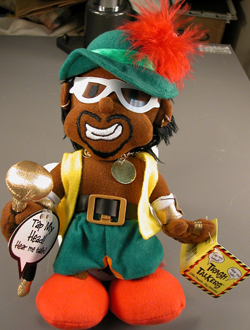
David Chang promotes his product every bit a satirical critique of American racism. He is non alone. AdultDolls.net is the distributor of Trash Talker Dolls, a ready of dolls with stereotypical depictions of minorities. Their best seller is Pimp Daddy, a chain-wearing, gaudily dressed, black pimp who says, among other things, "Y'all better brand some money, bowwow." Charles Knipp, a white man, has gained national notoriety for his minstrel-drag "Ignunce Bout." Knipp, dressed in ragged women's clothes and blackface makeup, adopts the phase persona Shirley Q. Liquor -- a Coon-like blackness woman with 19 children. This self-proclaimed "Queen of Dixie" has many skits -- each portraying all blacks as buffoons, whores, idlers, and crooks. Knipp's performances are popular in the Deep South; still, he has been protested in many northern cities (Boykin, 2002). Shirley Q. Liquor collectibles -- including cassette tapes, drinking glasses, and posters are popular. When satire does not work, it promotes the affair satirized. Ghettopoly, Trash Talker Dolls, and Shirley Q. Liquor skits and products portray blacks equally immoral, wretched, ill-bred, cultural parasites. These mod depictions of blacks are reminiscent of the negative caricatures found more than a century ago. The satire does not work just the distributors get paid.
Understanding is the principal affair. The Jim Crow Museum'south holdings force visitors to take a stand for or against the equality of all people. It works. I have witnessed deep and honest discussions well-nigh race and racism. No topics are forbidden. What office accept blacks played in perpetuating anti-black caricatures and stereotypes? When, if ever, is folk fine art racially offensive? Is segregation forth racial lines e'er indicative of racism? We analyze the origins and consequences of racist imagery, only we do not stop at that place.
I am humbled that the Jim Crow Museum has become a national resource -- and the museum's Web site, an international resource. The Web site was created by Ted Halm, the Ferris State University webmaster. Two dozen Ferris State University kinesthesia have been trained to function as docents -- leading tours and facilitating discussions nigh the objects. Traveling exhibits are being conceptualized and built to carry the museum's lessons to other universities and colleges. Clayton Rye, a Ferris State Academy professor and filmmaker, and I created a documentary about the museum. John Thorp served the museum well as its director until his retirement, as does electric current director Joseph "Andy" Karafa. The museum is a team attempt. A vision without assistance is a cathartic dream.
I meet my part as decreasing. I have other goals, other garbage to collect. I have nerveless several hundred objects that defame and belittle women -- items that both reflected and shaped negative attitudes toward women. 1 day I will build a room, modeled afterwards the Jim Crow Museum, that uses sexist objects to teach Americans to amend sympathise sexism. That room will exist chosen "The Sarah Baartman Room," named after a 19th century African adult female brutally mistreated by her European captors. Her victimization was a "perfect" illustration of the links betwixt racism, sexism and imperialism. There is an African maxim that says that we do non die until we are forgotten. It is my intention that Sarah Baartman never dies.
Martin Luther King, Jr. said, "Injustice anywhere is a threat to justice everywhere." In 2004, Carrie Weis, the Manager of the FSU Art Gallery, and I designed and built a traveling exhibit called, "Hateful Things." This exhibit has traveled to many universities and museums teaching nigh the horrors of Jim Crow segregation. In 2005 we began building, "Them," a traveling showroom that focuses on material objects that defame not-blacks, including women, Asians, Jews, Mexicans, and poor whites. Once more, our goal is to use items of intolerance to teach tolerance.
I will stop with a story. One of my daughters plays on an elite soccer team, meaning her practices are never done on time. One day I sat in the van with my other daughter waiting for exercise to end. Nearby several white boys were clowning in forepart of ii girls. They were all teenagers. Ane of the boys wore a blackfaced mask and he mocked the mannerisms of "street blacks." He turned toward united states of america and I immediately looked at my daughter. She had lowered her head and covered her face. If you lot have a child and then yous know what I felt. If your peel is nighttime then you know why I do what I practise.
© Dr. David Pilgrim, Professor of Folklore
Ferris State University
Feb., 2005
Edited 2012
ane Kennedy (1990, p. 234). This book, originally published in 1959, is a profound-albeit, often satirical-critique of the racial hierarchy that operated during the Jim Crow period.
2 As founder of the National Brotherhood, the largest neo-Nazi organization in this country, Pierce used weekly radio addresses, the Internet, white power music ventures, and racist video games to promote his vision of a whites-only homeland and a authorities gratis of "non-Aryan influence." Pierce died on July 23, 2002, his followers take vowed to carry on his work.
References
Boykin, K. (2002). Knipped in the barrel: Protests close NYC drag 'minstrel' show. Retrieved from http://world wide web.keithboykin.com/manufactures/shirleyq1.html.
Faulkner, J., Henderson, R., Fabry, F., & Miller, A.D. (1982). Ethnic notions: Blackness images In the white mind: An exhibition of racist stereotype and caricature from the collection of Janette Faulkner: September 12-Nov 4, 1982. Berkeley, CA: Berkeley Art Center. The images in this book inspired Marlon Riggs' documentary, Indigenous Notions.
Kennedy, S. (1959/1990). Jim Crow guide: The style it was. Boca Raton, FL: Florida Atlantic Academy Press.
Macdonald, A., & Nothing, D. (1978). The Turner diaries. Washington, D.C.: National Brotherhood.
Pilgrim, D. (Producer), & Rye, C. (Director). (2004). Jim Crow's museum [Motility picture]. The states: Grim Rye Productions.
Riggs, M. (Producer/Director). (1987). Indigenous notions [Motion moving-picture show]. U.s.: Signifyin' Works.
Robeson, P. (1958). Here I stand up. Boston, MA: Buoy Press.
Woodward, C. V. (1974). The strange career of Jim Crow (3rd rev. ed). New York, NY: Oxford University Press. This book remains a classic critique of Jim Crow laws and etiquette.
Back TO JCM Domicile
Source: https://www.ferris.edu/HTMLS/news/jimcrow/collect.htm
0 Response to "Is the Charter of Will on Dool Being Written Out Again? Is Will Going T O Die?"
Post a Comment